
When I was in college I figured out that I paid the same tuition if I took eight units or 17 units. So, I figured I’d find some classes outside my major to take for fun. I enrolled in 12-15 units toward my degree and then I frequently enrolled in another 1-2 units of classes that just seemed interesting. Along the way I took modern dance, tennis, yoga, and several Outdoor Studies (now called Wilderness Studies) classes. I started with backpacking my sophomore year. Later I went on to take rockclimbing, kayaking, another backpacking class, and winter mountaineering. My experiences in those classes taught by the wonderful Bill Webb forever changed my outlook on the outdoors, teamwork, physical endurance, and my own ability to meet challenges.
I’m not quite sure why I chose backpacking, considering I had traveled very little in my life and had never even been camping. I was raised by intellectuals who placed great value on academics and learning. My mom, dad, and stepdad were all teachers and my mom and stepdad also became administrators later in their careers. I am grateful in the way they instilled curiosity and a love of learning in me. But, I didn’t play sports and I had little experience with activities that were physically strenuous or difficult. So, taking a backpacking class was a pretty big stretch.
In each of these classes, we learned about how to be safe in the wilderness–carry our 10 essentials, travel in a group, tell someone where we were headed, respect nature and her changing moods. Each class addressed various topics from specific guidelines on the equipment we would need, to physical conditioning. (In preparation for kayaking, we were giving a piece of pvc pipe and a rope on which we were directed to tie a gallon jug filled with water. The idea was to wind up the rope to strengthen our arms in preparation for very long days kayaking on Lake Powell.) We were also assigned reading, writing, and research projects. For the kayaking class I read Everett Ruess: A Vagabond for Beauty and learned about his life and disappearance in the area where we would be. I also read Edward Abbey’s Desert Solitaire for one of the other classes. I researched avalanches for the winter mountaineering and learned what conditions cause avalanches to be likely and how they are often triggered. I researched how to tell time by the stars and how to prevent and treat hypothermia.
At the end of each course, we went on a trip to backpack, kayak, or climb. My first backpacking class only involved a few days in San Jacinto above Palm Springs. The culminating activity for kayaking involved two weeks paddling Lake Powell. We traveled to Joshua Tree for rockclimbing. Winter mountaineering took us to Mammoth for a week or so. We carried our backpacks while traveling on cross-country skis. These trips were an opportunity to put what we had learned to the test. Each time I was way out of my comfort zone. The physicality of each experience was very challenging for me. But, I was highly motivated to keep up and not complain, especially since women were outnumbered 3-4 to 1. 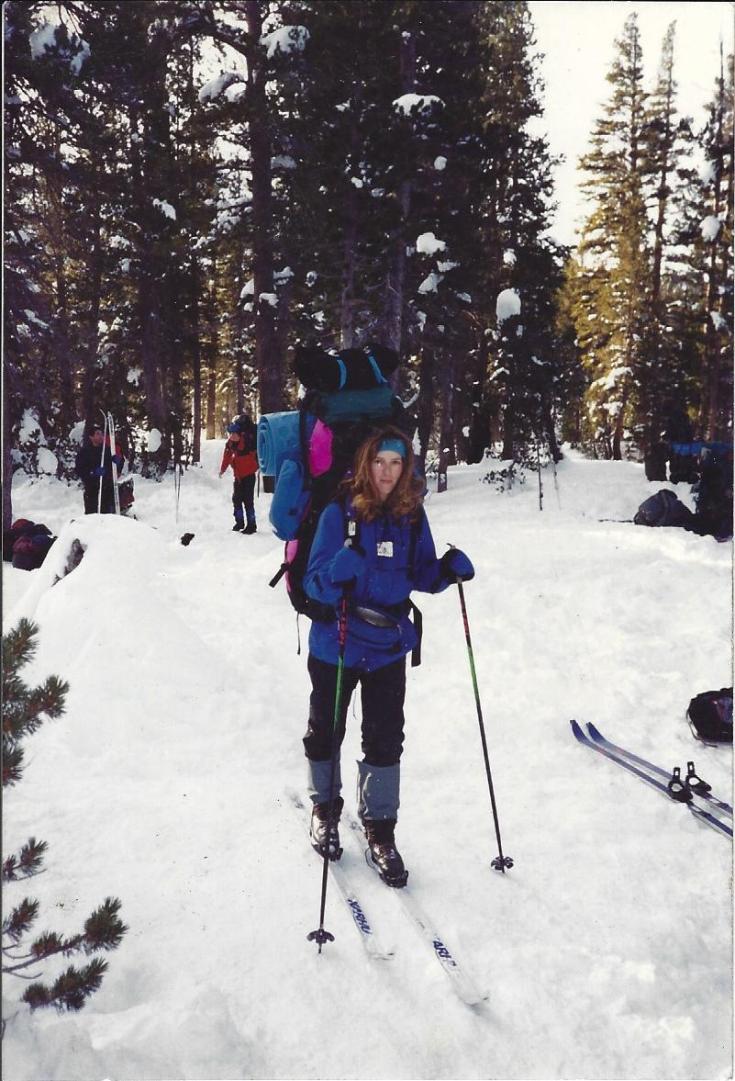
To be clear, these were not easy outings. When backpacking (with a pack that was about 50+ lbs. and I weighed about 135 at the time) we would typically hike about 10 miles a day. When kayaking, we would wake around sunrise and paddle for 20-25 miles. Rockclimbing involved hiking to our climb site and then, well . . . rockclimbing all day. (This was long before the popularity of indoor climbing walls. We climbed actual rocks.) Winter mountaineering was really tough. Everything was a challenge–getting up after toppling over on cross country skis with a heavy backpack, melting and boiling enough snow to cook food, staying warm. It was cold. I woke one morning and the thermometer on my backpack read 0° F. When nature called it was a tricky balancing act–especially for a woman. I’ll let you imagine that on your own. We built snow caves (a requirement for the class), traveled for miles, and went for a ski to warm up when we got cold.
There was one particular incident though, that really sticks with me. One year I took a summer session backpacking class. This trip was longer–two weeks–in the Wind River Range in Wyoming. The mosquitoes were vicious. Insect repellent was effective, but when we decided to take a sponge bath, we would have a friend stand behind us to swat away the mosquitoes with a shirt because as soon as that insect repellent was washed off they would attack. Though it was July, snowfields could still be found. Our instructor required us to carry ice axes. One day our activity was to learn how to stop ourselves with an ice ax if we were ever to slip and fall on snow. We were instructed how to rotate our bodies to jam the ice ax into the snow to stop our slide in four ways–feet first on our backs, feet first on our bellies, head first on our backs, head first on our bellies. One of the student leaders demonstrated and we lined up to practice. I was scared to death. I procrastinated and waited. I hoped I would get out of this task, after all, I was taking this class for fun, right? I was so frightened that I cried. I didn’t make a scene about it, but I was petrified. Bill Webb, my amazing instructor was patient. He listened to me say that I couldn’t do it. And he told me I could . . . and that I would. He waited . . . and waited. And, it became clear to me that he wasn’t going to let me off the hook. So, I took the plunge and managed to stop myself from skidding into the rocks below with just my ice ax.
I often think about that day in Wyoming–when I’m faced with a situation that intimidates me. I also think about Bill Webb and how his calm stubbornness was the nudge I needed. I’ve used that same technique many times in my speech classes with students who are battling stage fright.
It has been over two decades since I learned to backpack, kayak, and rockclimb, but the lessons learned stick with me.
- Preparation and having proper equipment matter. Hiking boots must fit well and be sturdy. (Check out Cheryl Strayed’s Wild for details about what can happen when hikers do not have boots that fit properly.)
- Our decisions and actions affect others. If one person in the group gets injured, everyone must adjust, so it is important to be safe, stay hydrated, avoid hypothermia, and check the ego.
- Climbing up a rock is as much about problem solving as it is strength and conditioning. Not having the same upper body strength as many of my male companions, I relied more on footwork and balance.
- Food tastes better outdoors. Ashcakes were a wonderful treat after kayaking all day. (But a burger on fry bread after two weeks camping tastes even better.)
- Lakes fed by snow runoff result in sponge baths.
- We are capable of much more than we think we are.
- When presented with tough situations, the right person can push us well beyond what we think we are capable of.


 Update-Ed
Hi Mitzi, I loved your post! I also went though many of Bills classes. I’ve been out of touch with him for years. If you know how to reach him could you let me know? Thanks!
LikeLike
I’ve been out of touch with him for many years, too. I searched online for him and his son, but didn’t find much. I would sure love to tell him about the lasting impact he has had on me.
LikeLike