
Last week I balanced on a two-drawer file cabinet and taped tag board over windows with painter’s tape. The results are not very aesthetically pleasing, but they will do the job. My husband’s high school students will no longer be blinded by the sun in the afternoon.
Several years ago city residents passed a bond measure to renovate the schools in the district. There were several components including classroom floors, electrical work to accommodate ceiling-mounted projectors, new drinking fountains . . . and windows. The first of four high schools elected to get new windows, so the remaining three high schools were required to get new windows, too, in the interest of equality. As part of the renovation, the really old, dirty, sticky vinyl curtains were removed. (Did I mention they were sticky? How do they get sticky?) The new windows look nice and are tinted. But, that’s the problem . . . it’s a slight tint. The sticky curtains were removed, but not replaced because (we were told), the windows are tinted. So, if a teacher wants to darken the room to show a video clip or slides of some kind (using the ceiling-mounted projector), the room can never really get dark enough. The south side of my husband’s classroom does not have eaves. So, in the afternoon, students in the first row have the sun shining directly into their eyes (though they do look angelic sitting in a circle of light). These are the windows I covered. On the other side of the room the windows run much lower and allow any student or adult to see inside the classroom.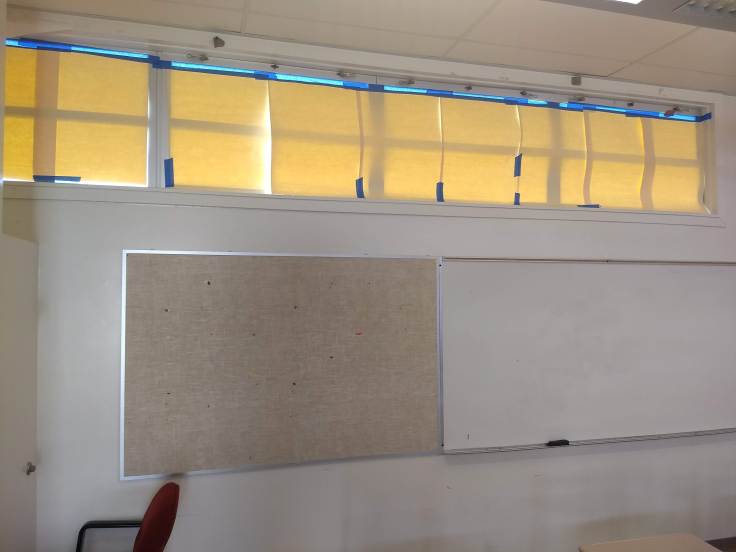
There is also no way to conceal the presence of a class in the event of an active shooter situation. (Yes, we have to consider these things now.) At one point, there was discussion of building up the wall on that side of the rooms so windows would be above sight-lines in the interest of safety. I’m not sure why that project was ultimately removed from the plan
Walk around campus and you’ll see how various teachers have addressed this issue. Some are crafty and have made fabric “window treatments.” Others purchased “temporary” paper blinds. Some used construction paper, butcher paper, or tag board and masking or painter’s tape to cover windows. Aside from the money spent by teachers on materials, there are time and safety factors to consider. Teachers and their friends, significant others, and spouses stand on furniture or sometimes actual ladders in order to reach the top row of windows. What if one of them fell? Who would be at fault?
But, there’s another issue. What do students see when they walk into classsrooms? What do they learn about planning and the value adults place on their experience in school when they learn that millions of tax dollars were spent on windows and now they cannot see videos and slides clearly, they have to shade their eyes in class, and will be left vulnerable should there ever be an active shooter on campus. I suppose you could say that they learn that their teachers come up with some creative solutions to problems and just handle them. But, most of the solutions, save for the very crafty types, look messy and unattractive. (Yes, I’m saying my handiwork looks messy and unattractive.) We tell students to present themselves well in their speech and attire and to complete assignments neatly. These jury-rigged window coverings do not model these lessons well.
But the renovations didn’t stop there.
Students used to complain that the drinking fountains were either inoperable or filthy. Renovation meant sparkling clean new water fountains. Only they didn’t stay that way long. Water pressure is often low and the porcelain is covered in dirt. So what do students do? They buy water. We want to reduce waste and trash–for the environment, but also to keep school clean and not burden adult custodians with cleaning up after teenagers. Yet, hundreds of kids are buying water in single-use bottles daily. We want them to be fiscally educated and responsible for their belongings. Many schools now have water bottle fillers. And some sell reuseable bottles with the school name/mascot which not only would reduce waste, but also work toward building school pride. But, here students are again sent the message that something so basic as access to clean water fountains is not a priority. Yes, part of this is perception. Students think the water from the fountains is dirty, so they don’t use them. They are not used, so they get dirty. Something is missing here.
I realize there are many schools across the country with facilities in great disrepair. There are old schools in communities where bond measure aren’t passed. But, I think many in this community where a 800-square-foot, two-bedroom, one bath home in the shadows of the school stadium is listed at $580,000.
The physical facilities communicate volumes to kids about the pride they should have in their schools . . . and the value placed on their education by the district and community. What are they learning when their classroom windows are covered in tag board and their drinking fountains are filthy? It may seem like these are minor issues, but these things add up. Walk around your school or your kids’ school. What do lessons do you take away from the buildings, paint, lunch benches, windows, and water fountains?
 Update-Ed
Leave a comment