
Teaching is not for the faint of heart. It is exhilarating, rewarding, frustrating . . . and exhausting. A traditional school year consists of 180 school days. With approximately 35 students each (Yes, classes are that large here! How big are they where you live?) in five classes, there is a lot of human interaction over the course of a school year. For the sake of argument, let’s say that a high school teacher interacts with 150 students a day (some classes may be a bit smaller and there are absences) every day, for 180 days. That’s 27,000 human interactions a year (not counting those with colleagues and students we come into contact with through clubs, extracurricular activities, etc.)
We’re talking teenagers . . . at a public high school. This is a huge mixed-bag of of hormonal humans.
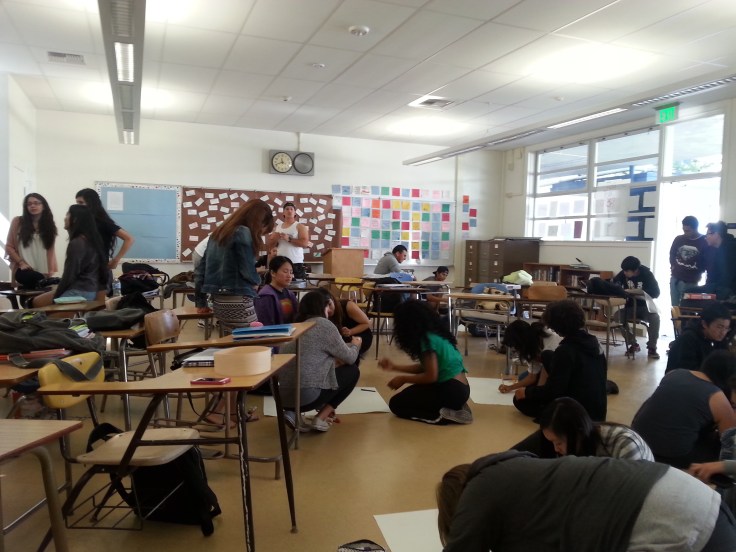
With talk of objectives, outcomes, and standards, this very human element can sometimes get lost. We sometimes forget that each of these people has his or her own successes, struggles, and story. We push through in the effort to deliver the same content to everyone and to hold them to high standards. But, they are still people and people are messy and complicated.
We don’t always know what burdens students carry. It may be late in the year before we learn that a student has lost a sibling or parent in recent years or that they are caring for an aging grandparent or that they care for a younger sibling in the afternoon or that the family is struggling financially. Not that we can remove these challenges, but being reminded that a student’s entire life does not revolve around our class brings it into perspective.
At one point in my career, I taught at a Community Day School serving students in grades 7-12 who had been expelled. Not surprisingly, nearly every student there carried a great burden: food insecurity, past traumatic experiences, struggles with drug abuse (their own or within the family), violence in the home or neighborhood, etc. These circumstances did not provide an excuse, but it was a stark reminder of why most of them struggled so much in school. All the formative assessments, standards-based instruction, student-led activities, genius-hour projects, and lessons on growth-mindset, grit, and mindfulness wouldn’t change their circumstances. (Not that these techniques don’t have value.) Instead, we have to take students where they were and try to move forward.
I was recently reading through writing reflections I assigned students in a class I’m teaching at a community college. I wanted them to think about their strengths as writers, as well as recognize areas where they could improve. I also wanted to make sure they reviewed my detailed comments. (Because they submit work online, I can see if they neglect to return to the assignment after it has been graded to view feedback.) I ask a few questions about the comments they receive and what they plan to remember (keep doing what is working) and work on (improve) for the next assignment. I also ask, “Were there factors that may have contributed to a lower score than you hoped for? If so, explain. (Not excuses, but circumstances, gaps in understanding, etc. such as “I had many papers/tests due at the same time.”; “I was busy and was pressed for time. It wasn’t my best work.”; “I had difficulty deciding on a topic.”; “I procrastinated.”; “I submitted late.”). The responses are so revealing. Several students indicated that they are having difficulty adjusting to the expectations of college or balancing work and school. Some are caring for ill or aging relatives, commute a long distance, or have their own children to care for and so, their schedule is not always predictable. Not one student presented an excuse or “sob story.” Instead, they reflected on what is within their control and what they can to do adjust. Granted, these are adults. But, I was struck that I needed the reminder that just because a student may not submit their best work or may miss a deadline, it’s not always because they don’t care about the class or their performance. It’s not necessarily an indication of lack of effort or laziness. It becomes my job to stay with them and encourage them to keep at it and not write them off.
It’s a tricky balance having high expectations for 150 individual students on any given day. It’s hard to be fair and kind and supportive with 150 individual personalities. Yet, as exhausting as it is, we have to try.
 Update-Ed
Leave a comment