
Last week I went to Back-to-School Night at my son’s high school. Having taught high school for over 20 years, I had a good idea of what to expect. Most of his teachers were warm and professional. The parents were sweaty and tired from racing from one end of campus to the other in five-minute passing periods. (The kids get 10 minutes.) There was one simple omission by a teacher that stands out to me, though.
As I walked into the gym to hear about physical education (PE), I was directed to an area of the bleachers for ninth-grade PE (as opposed to weight training on the other side). Clearly there were several classes of PE offered that period. There were two teachers/coaches, but only one did the talking. He spoke about physical fitness training, grading, and “dressing-out” (changing into PE clothes). It was informative. But there was one thing missing. He never introduced himself or the other teacher/coach. Sure, the PE classes are (supposed to be) run the same way, so it shouldn’t matter which teacher my kid has. But, it’s just insensitive and rude to not introduce yourself to a room full of people who don’t know you. I wasn’t even sure which of the men was my son’s teacher.
Adults in schools sometimes forget that not everyone knows who they are, and as a result the social nicety of introducing oneself is forgotten. This is a problem because it separates those who are “in the know” and those who are on the outside.
Just this week I was at a meeting for my job, and the presenters did not introduce themselves. Not everyone in the room knew their names and they did not know everyone in the room. By not introducing themselves, it set a tone of exclusion for those of us who didn’t know who they were. Pretty telling, don’t you think?
Social niceties are important to model for our students–especially in high school. Too often we complain about how rude teenagers are. And, yes, we may need to remind them to take their earbuds out when coming in at lunch to ask a question, or to ask us (using please and thank you) when requesting a signature on a permission slip, grade check, etc., instead of just shoving it in our faces. But, adults don’t get a pass and sometimes they are the worst culprits.
At one high school where I worked, it was common to see parents wandering aimlessly in the office searching for the counseling office, attendance or records clerk, an administrator, etc. Teachers and other adults would rush past them instead of asking who they were looking for and offering assistance. Not the most welcoming or confidence-inspiring experience to have at your child’s school, is it? Now there are security measures in place, so this is a less common occurrence, but it’s still revealing about the school culture.
But, it wasn’t just the dismissal of parents that was telling. Phone etiquette was another frustration of mine. People calling from outside campus could not ring directly through to classrooms, but faculty and staff could. Many times my phone would ring during class and an adult would launch into questions about a procedure, a specific student, or with a technology question. The problem was two-fold. One, these calls often came in during class . . . when I was teaching. Two, the caller often failed to announce his/her name. Usually I recognized the voice, but not always. So, I started simply asking “And, to whom am I speaking?” Passive-aggressive? Maybe, but it was just so off-putting to pick up the phone not knowing who was on the other end and have him/her simply assume I would recognize his/her voice with no introduction. How hard it is to say, “Hey Mitzi, this is John. I have a quick question. Do you have a moment?
But, the worst example of adult rudeness occurred when my students gave formal speeches. Years ago I started having students fill various classroom jobs during these presentations. One would be a videographer and another would be the “bouncer.” (No, there wasn’t a velvet rope, they didn’t check IDs or throw anyone out.) The bouncer was charged with sitting in a high chair on casters in the doorway. He/she would block people from entering the room. This was to prevent the delivery of call slips to the office and other notes from interrupting the speaker. And, these were delivered frequently. Rarely did we get through a class without some kind of interruption. The student bouncer would politely ask for the papers and would hold them until the speaker was finished and then would give them to me to distribute. Of course, I instructed students that if an adult arrived and had an urgent need to speak with me, to direct them to the back door so they could enter in the back of the room where I sat during speeches.
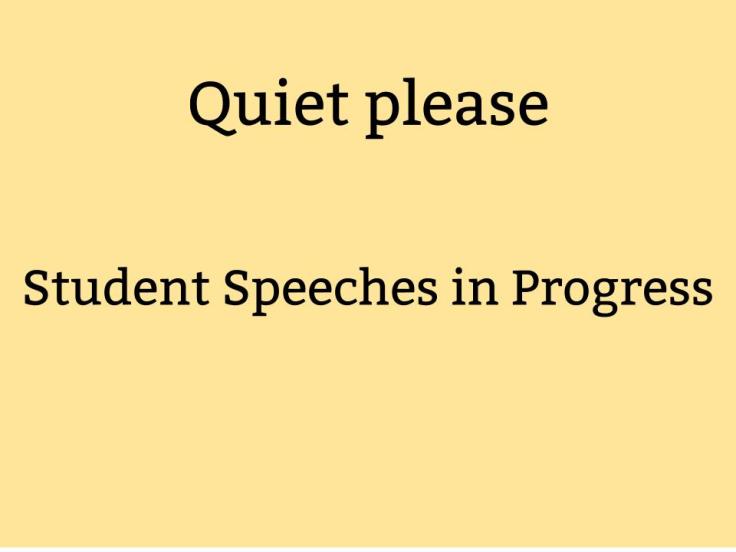
Having the bouncer had a few benefits. Students had a visual reminder not to interrupt speakers. Speakers were reminded that they had the floor, it was their time, and they should do their best. When student aides arrived with call slips and notes, things went smoothly because the bouncer would quietly collect them. But, when adults came by, they almost always pushed past the bouncer and walked right in–often directly in front of the student speaker. Then they would find me and start talking to me–WHILE A STUDENT WAS GIVING A SPEECH. I would usually whisper a quick response and indicate that we could talk later. Not once was the interruption an emergency or something that couldn’t wait.
This made me furious because kids (well, most of them) spent a lot of time preparing these speeches. Formal speeches were a big part of their grade and I had an obligation (and desire) to really listen to what they had to say. It’s tough to be a teenager and give a speech before your peers and it’s hard to get back on track when you’re interrupted. And, here an adult just disrupts things for a student without any awareness of how rude they are being. What was even more telling was the response of my students later. After the interrupted speech was over, they would mutter about how rude the adult was, or ask me what was wrong with them, or laugh at how clueless the adult was. Some recognized the level of disrespect that was demonstrated to me, my class, and especially to the students. We had all been dismissed because an adult believed his/her question was more important than what was going on in this class.
In these often rushed, noisy, sometimes contentious times, we have to check ourselves. Does the culture of your school encourage decorum and polite behavior . . . or does it exclude and dismiss other adults and, more importantly, students?
 Update-Ed
Leave a comment