
I know educators who say they don’t accept late work. I understand that students must be accountable and that meeting deadlines is part of life. I often hear the reasoning that “life doesn’t accept late work” or something along those lines. But, is that really true? If I fail to pay my property taxes on time, does the assessor simply refuse my payment? Of course not. Yes, I have to pay a penalty, but I can still pay. This is the case in many circumstances. Sure, there are times when a deadline passes and there is no going back, but these are students we’re talking about. In my case, these students are adults with jobs, families, responsibilities. And, things come up that derail them sometimes.
Recently I was chatting with another educator and she said she simply does not accept late work. She went on to say that actually she would accept late work . . . in “special circumstances.” Sounds fair, right? But, is it really? How do we define “special circumstances?” Who are we to judge what is a legitimate excuse? Would we require proof–a doctor’s note perhaps? But, what if the circumstance is a bipolar family member who has an off-day and causes a student to miss school? Or, in the case of adult students, what about the boss who requests they fill in for someone who didn’t show up? There’s no doctor’s note “excuse,” but these are certainly justifiable reasons, right?
But, there is a danger to knowing the circumstances students face. This can lead us to unfair practices. For instance, do we extend a deadline for a student who (in the case of community college students) has a sick child and needs to miss class. Or whose car broke down on the way to school? Do we only extend deadlines for those with the best story? How do we verify the truthfulnes of the stories? I, for one, hate being put in the position to evaluate the reason for a missed assignment. I also don’t want to encourage my students to lie to me and come up with a “good excuse” for missing a deadline, just so they may be granted an extension.
This is why I give each student a one-time late pass. Students can use it for a three-day extension on major assignments, no questions asked. It’s a safety net for when life gets in the way of school.
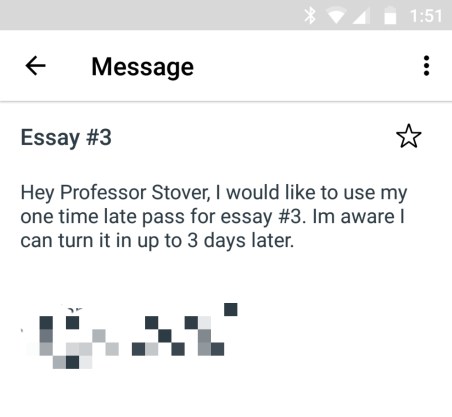
This has another huge benefit. No longer are the students with the best story . . . or the best storytelling skills, the only ones who get a reprieve. I worry that when we claim “no late work is accepted,” but still make exceptions for “special circumstances,” that it will be the articulate, outgoing, attractive student who will be granted extra time, while the introverted student or the one who hasn’t quite honed the ability to advocate for his/herself . . . and, let’s face it . . . play the game, will simply be penalized. The one-time, no questions asked late pass is egalitarian. Everyone gets the same shot. And, I don’t have to worry that I am being manipulated or look for holes in a story that may or may not be true. Students with legitimate reasons are also permitted to keep these circumstance private.
Sure, there are still times when we have to make a judgment call. But, it seems to me that this really simple tool gives students control and security in knowing that when unexpected challenges arise, they will have a safety net.
 Update-Ed
Leave a comment